

We are pleased to announce that the 8th IEEE International Conference on Universal Village (IEEE UV2026) will be held virtually and locally from October 17-20, 2026.
We warmly invite you to join our IEEE UV2026 conference! Accepted papers will be submitted for inclusion into IEEE Xplore subject to meeting IEEE Xplore’s scope and quality requirements. We greatly appreciate your leadership and contributions to UV!
- Universal Village (UV) is a new concept proposed by MIT’s Universal Village Program in 2012. Universal Village (UV) exemplifies an ideal future society that pursues harmony between humans and nature through the wise use of technology.
- The IEEE UV Conferences call for collective efforts from world-renowned experts across multi-disciplinary fields to collaborate beyond traditional field boundaries. Previous IEEE UV conferences (UV2013, UV2014, UV2016, UV2018, UV2020, UV2022, and UV2024) were groundbreaking international venues that inspired successful collaboration among governments, academia, industries, and civil society.
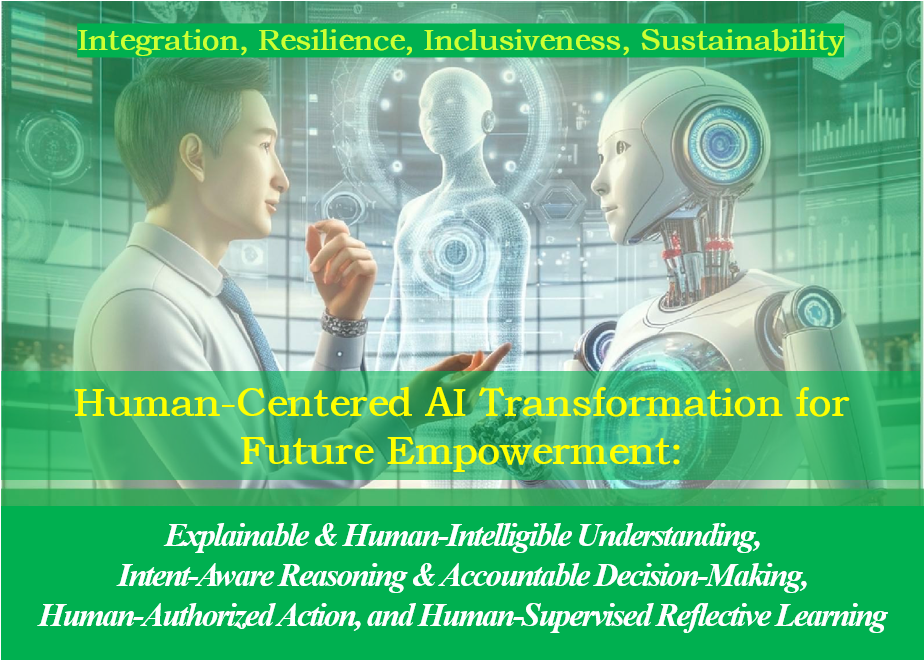
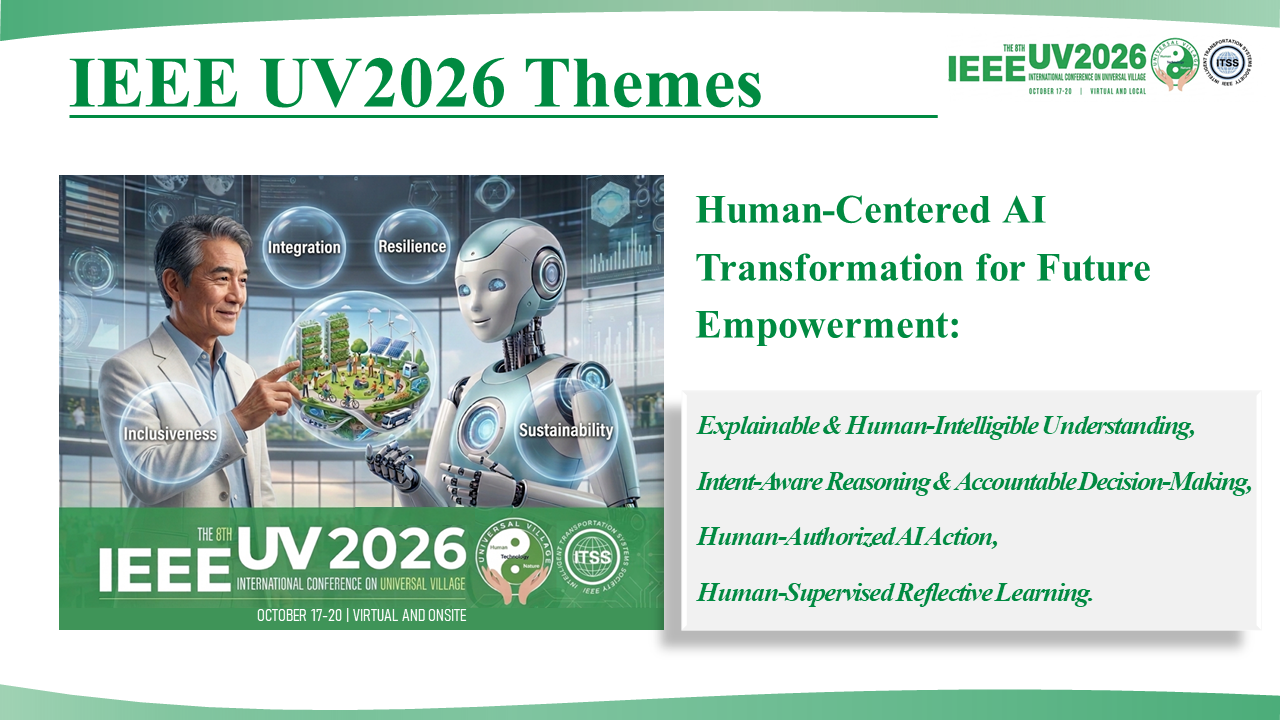
- IEEE UV2026 features the theme of “Human-Centered AI Transformation for Future Empowerment: Explainable & Human-Intelligible Understanding, Intent-Aware Reasoning & Accountable Decision-Making, Human-Authorized AI Action, and Human-Supervised Reflective Learning.”
- Specifically, IEEE UV2026 features the following topics:
-
- The Human – AI Relationship and AI-Pervasive Societal Transformation
- Developing systematic methodologies to advance UV technologies and to develop UV systems, including Intelligent Transportation Systems, Urban Planning and Crowd Management, Smart Infrastructure, Smart Response Systems for Emergencies, Smart Energy Management, Smart Environmental Protection, Smart Home and Community, Smart Medicine and Healthcare, and Smart Humanity
- New lifestyles enabled by IT / New energy / New materials / Effective microorganism technology and environmental protection
- Exploring UV development paths that are appropriate for different regions at different development phases, from theoretical exploration, research development, framework design, implementation, engineering, to integration
- Inspiring successful collaboration among governments, academia, industries, and civil society to address different UV challenges and seek practical UV solutions
-
- IEEE UV2026 will hold sessions for scientists, students, engineers, entrepreneurs, and government representatives to share their perspectives on various research areas.
Part I: Technical Session Details
【Submit Short or Regular Papers】
- [TS1-A] Vision for Universal Village
- Vision for Universal Village: Cities’ Smartness, Efficiency, Safety, Environmental Qualities, and Inclusiveness
- [TS1-B] Development Status of Universal Village
- Development status of current smart cities in different countries
- Discussion of limitations and challenges
- [TS1-C] UV Indices, UV Incentive Mechanisms, and Evaluation of UV Subsystems – Methods, Technologies, and Systems
- UV Indices: Quantitative Indications of Cities’ Smartness, Efficiency, Safety, Environmental Qualities, and Inclusiveness
- Incentive Mechanisms for the Development of UV-Oriented Systems
- Evaluation of current methods and technologies for UV subsystems
- Smart Homes and Communities
- Smart Medicine and Healthcare
- Intelligent Transportation, Urban Planning, and Crowd Management
- Smart Energy Management
- Smart City Infrastructure
- Smart Response Systems for City Emergencies
- Smart Environmental Protection
- Smart Humanity
- Analysis of impact factors for different UV subsystems
- Information flow
- Material cycle
- Lifestyle: issues such as food waste
- Community
- Subsystem coordination and interaction analysis: Analysis of the mutual interactions among UV subsystems and evaluation of the system coordination
Seeking integrated, resilient, human-centered, sustainable and environment-friendly solutions under the concept of Universal Village
- [TS2-A] Systematic and Integrated Frameworks for UV Subsystems and Contributing Factors
- [TS2-B] Intelligent Modeling, Simulation, and System Analysis
- [TS2-C] Scalability, Sustainability, and Human-Centered Design in UV System Integration
- [TS3-A] Intelligent Transportation, Urban Planning, and Smart City Infrastructure
- Interconnected transportation systems; intelligent road transportation management; safety enhancement based on the interaction among passengers, vehicles, event planners, and other stakeholders
- Coordinated traffic control; smart parking; urban planning
- Smart logistics and distribution services; last-mile delivery
- Smart facilities; smart construction; smart lighting/heating/cooling/ventilation systems; smart sewerage and sanitation systems; smart water and waste management
- Coordinated city infrastructure development and operational management; smart infrastructure lifecycle management; predictive analytics for identifying infrastructure vulnerability
- [TS3-B] Intelligence Vehicles, Mobility Support for Vulnerable Groups
- Autonomous vehicles; drones; intelligent electrified vehicles; smart wheelchairs; robotic exoskeletons for vulnerable groups
- Intelligent driving assistance systems; navigation and localization systems; vehicle hardware/software systems; vehicle on-board diagnostics; vehicular signal processing; smart cockpits
- Human-oriented sensing and recognition for vulnerable road users and animals; intercommunication among passengers, vehicles, and traffic lights
- Connected vehicles; vehicle dynamics and control
- Human factors; cognition and control; driver monitoring
- Policies and regulations for intelligent vehicles
- [TS3-C] Smart Response Systems for City Emergencies
- System vulnerabilities identification; crisis prevention and city robustness reinforcement; crowd management
- Emergency (natural disasters, crimes, accidents, etc.) prediction, detection and management; cyber-security; smart alerting and hierarchical information collection and distribution; active disaster response and recovery
- [TS3-D] Information Flow, Communication, Networks, and Security
- Smart data acquisition; mobile sensing; crowdsourcing; the Internet of Things; seamless wireless networks; information and communication technology (ICT) infrastructure
- Information integration; information storage, sharing, circulation, and visualization; cloud service; blockchain; data repository
- [TS3-E] UV Underground: Underground Infrastructure & Future Urbanization Needs
- Cutting-edge digital tools and artificial intelligence in underground space and broader civil engineering
- Carbon emission reduction, renewable energy in subsurface engineering for the sustainability to Universal Village
- Big data mining, synthetic data and data analytics for underground structures and Universal Village.
- Advances in architecture, urban planning and other socioeconomical sciences and technologies specifically tailored for underground universal village society, etc.
- [Special Session][TS3-S] Algorithmic Modeling and Generative Artificial Intelligence for Sustainable Built Environments
- Generative design and AI-driven spatial modelling of human habitats
- Algorithmic Zoning and 3D pre-visualization of environmental policies
- Computational tools for sustainable urban morphology (e.g., parametric modelling)
- Technology-based reciprocal models promote regional integration and urban cluster integration (e.g., the Bay Area).
- [TS4-A] Renewable Energy and Smart Energy Management
- Renewable energy capture and conversion, emerging technologies
- Solar energy: photovoltaics, solar thermos
- Wind energy: wind turbine materials and novel designs
- Hydrogen energy: solar splitting water, fuel cells
- Other energies: biomass, renewable natural gas, hydroelectric energy, blue energy
- Energy storage devices and technologies (batteries, supercapacitors, and fuel cells)
- Smart grids; transmission infrastructure; integrated energy management for high efficiency and zero-emission; theoretical simulations of renewable energy and its applications; smart meters; demand response management (DRM)
- Resilient operations against disturbances, unexpected errors, accidents, physical and cyber-attacks, and natural disasters
- Renewable energy capture and conversion, emerging technologies
- [TS4-B] Smart Materials and Devices
- Smart materials for advanced electronic devices (sensors, actuators, transducers)
- Smart materials for energy conversion (piezoelectric, magneto-elastic, thermoelectric, electrostriction)
- Advanced intelligent devices and systems
- Artificial Intelligence (AI) for materials development
- [TS4-S] Semiconductor Chip Manufacturing in the AI Era: Enabling 3D Optoelectronics & Next-Generation Integration
- Key Research Areas: Focuses on 3D optoelectronics and heterogeneous integration as key enablers of next-generation systems, highlighting advances in multi-layer photonic integrated circuits, vertical optical interconnects, chiplet-based architectures, and co-packaged optics.
- Manufacturing and System-Level Perspectives: Emphasis on a manufacturing-aware, system-level perspective that addresses yield, reliability, thermal management, and scalability challenges, as well as the gap between laboratory innovation and high-volume deployment.
- Collaborative Innovation: Outline a pathway for evolving semiconductor manufacturing to support energy-efficient, high-bandwidth, and scalable AI systems through tightly integrated electronic–photonic co-design by bringing together insights from academia, industry, and national laboratories
- Smart Manufacturing
- Cloud manufacturing
- Cloud-edge collaboration in manufacturing
- Additive manufacturing and robotics
- Planning and scheduling of manufacturing tasks
- Quality detection and control
- Large Language Models (LLMs) for manufacturing
- Computer vision and other AI technologies in manufacturing
- Realizing the Potential of Smart Agriculture – The Challenges and Chances of Rural Revitalization
- Vertical farming; smart crop/soil/pest management; precision irrigation; smart livestock farming; climate-smart agriculture
- Unmanned aerial vehicles (UAV), robotics, and automated machinery for agriculture
- Smart sensing and monitoring, Internet of Thing, big data analysis, predictive analytics (crop/disease/weather) and decision-making in agriculture
- [TS7-A] Smart Environmental Protection; Smart Ecological Systems
- Environmental protection: exhaust/wastewater/solid waste management; pollution control (air/water/soil; light/noise/radiation); effective microorganism technology; green roofs
- Challenges and solutions for climate change; restoration and protection of ecosystems; ecological economics and strategies; ecological informatics and acoustics
- [TS7-B] Mobility-enabled Material Cycles; the Circular Economy; Trash and Scrap Collection, Processing, Reuse, and Recycling
- Smart trash cans and their optimal placement; smart garbage trucks
- Smart recycling; smart residential trash and industrial scrap collection and transportation; circular economy; material reuse; second-hand markets;
- Cultural and economic factors; development of innovative lifestyles, public awareness and community engagement
- Crowdsourcing, data collection, and visualization for material cycles
- Material cycles optimization: smart waste management; smart trash and scrap processing, reuse and recycling; smart platform development for coordinated information sharing among smart recycling, user feedback on products and smart manufacturing
- [TS8-A] Smart Homes and Community, Virtual Living
- Smart appliances and devices; smart windows; intelligent deformation furniture; smart inventory management; smart home OS
- Safety and security; self-adaptive home-emergency response systems
- Smart life; fashion AI; home gardening and agriculture
- Intelligent support for vulnerable groups; homeless care; domestic violence protection
- Community support and virtual living during pandemic and other city emergencies
- [TS8-B] Mobility, Connectivity, and Innovative Lifestyles
- Integrated and technology-driven solutions to improve the quality of life: quantified self-devices and self-tracking technologies; smart textiles; VR/AR-based sports, entertainment and other activities; human-centered transportation, smart mobility and seamless transit systems; smart agents and human-computer interaction
- New lifestyles to reduce energy consumption and emissions: shared mobility and other new lifestyles made possible by the sharing economy; virtual tours; work from home; electronic surveillance
- Changing trends in cultures/technologies/lifestyles
- [Special Session] [TS8-S] Frontiers in Interdisciplinary Innovation Among Sports, Traditional Chinese Medicine and Western Medicine
- Artificial Intelligence–Enabled Sports Research
- Prevention and Rehabilitation of Sports Injuries
- Modern Assessment and Quantitative Analysis of Traditional Sports and Daoyin
- Correlative Studies between Meridian Sinew and Modern Fascial Science
- Health Monitoring and Intervention for the Elderly
- [TS9-A] AI Assisted Healthcare Monitoring
- AI for healthcare data acquisition, processing, and analysis
- Machine learning algorithms for ultrasound/MRI/CT imaging analysis
- AI for healthcare data security and privacy considerations
- [TS9-B] Smart Medicine and Smart Healthcare
- Healthcare system integration and interoperability; AI for healthcare logistics; Internet of Medical Things (IoMT); AI-powered hospital triage platform; robotics and automation in healthcare
- AI for medical diagnostics and screening; predictive modeling; telemedicine and virtual consultations; personalized medicine; 3D printing in medicine; wearable devices; pervasive and non-invasive health-monitoring
- Intelligent nurseries and senior care; assistive technologies for vulnerable groups; virtual care and mobile health
- Personalized healthcare and wellness management; smart diet and exercise; mental health; integrated medicine
- [TS9-C] Public Health, Epidemic Prevention and Control
- Alternative medicine; somatic science; community/rural/urban health; palliative care and hospice care; epidemic control and personal hygiene; equity and ethical issues
- Epidemic prediction and contact tracking
- Coordinated operational management across all levels during emergencies; smart resource allocation; quarantine and isolation; smart medical waste processing
- Crowdsourcing, data collection, and visualization
- [TS9-D] The Fusion of Traditional Chinese Medicine and Modern Science
- [TS9-E] AI-Driven Sports Training, Exercise, and Fitness
- [Special Session] [TS9-S] AI-Powered IoMT Telehealth Innovation
Explore the transformative role of the Internet of Medical Things (IoMT) in developing scalable, human-centered ecosystems and in creating a comprehensive Digital Health Ecosystem:
-
- Intelligent Monitoring: Recent advances in remote sensing, wearable biosensors, and pervasive, non-invasive health-tracking technologies.
- Edge Computing in Healthcare: Decentralized processing architectures, low-latency AI inference at the point of care, and energy-efficient onboard analytics for IoMT devices.
- AI-Enabled Care Delivery Systems: Design and implementation of AI-driven triage platforms, telemedicine frameworks, and decentralized care delivery models.
- Healthcare Data Infrastructure: Secure, scalable, and efficient architectures for healthcare data storage, predictive analytics, and interoperability across platforms.
- Ethical Deployment:
- From Research to Practice: Strategies to translate digital health and personalized medicine research into practice, and to scale innovations from controlled environments to real-world, large-scale deployment.
- AI for Equitable Healthcare: Human-Centered AI that promotes accessibility, equity, and security while bridging gaps in care and infrastructure in underserved communities.
- AI Governance & Policy: Developing ethical AI frameworks, audit and accountability practices, and IoMT regulatory policies.
- [TS10-A] Urbanization, Social Governance, and Smart Communities
- Urbanization: impact and challenges; geographical, cultural, and political factors
- Smart communities and neighborhoods; social media and support groups; community resource management; supporting infrastructure; data platforms and community clouds
- [TS10-B] Smart Government and Social Services
- Smart government: smart administration, regulation, policy and law; participatory governance; smart resource allocation
- Smart social services and social networks; smart education/training; civic engagement
- [TS10-C] Integrated Solutions for Smart Humanity
- New legal, social, and ethical challenges posed by applications of AI; integrated solutions: quantified analysis for the safety and ethics of intelligent systems; the social responsibility of enterprises; establishing legal, regulatory and ethical frameworks for development of AI
- Integrated solutions to promote diversity, inclusiveness, fairness, and the preservation of cultural heritage
- Ecological/environmental/humanistic/organizational psychology; persuasive technology
- Adaptive development strategies for various geographic regions at different developmental phases and people of different ages with diverse technology and cultural backgrounds
- [TS10-D] Smart Design and Design Ethics
- Evaluation of smart designs and their unintended consequences; emergent technologies for smart designs, simulation platform, and system optimization
- Interaction between different smart systems; impact of smart design on lifestyles, communities, and the environment; major challenges and impact factors of smart system design
- Coordinated design under the principles of usability, enjoyability, sustainability, inclusiveness, and cultural preservation; design ethics in the AI era
- Intelligent electromechanical design; Intelligent industrial design; Intelligent environmental design; Intelligent architectural and infrastructure design; Intelligent agent design; digital design; digital media art; visual media design; new media design; animation design; information and communication platform design; virtual environment design; design of logistics, crisis response, cities services and applications; multidisciplinary design
- [TS10-E] Cultural Heritage Preservation and Creative Industries
- [TS10-F] Equitable AI for the Underrepresented and Vulnerable Groups
- AI for Third World: for Integration, Resilience, Inclusiveness, and Sustainability to overcome Regional, Racial, and Gender Disparities
- Equitable AI: Address disparities in healthcare, education, and economic opportunities, and empower developing nations to reduce poverty
- Inclusive AI: Promote inclusion, particularly for marginalized and vulnerable populations, and ensure technological benefits for those in greatest need
- Human-centricity, Responsible AI, Trustworthy AI: Improve trustiness in AI systems, promote fairness, eliminate biases, for lasting societal benefits
- [TS11-A] Responsible and Ethical Data Management and Processing
- Data cleaning; data fusion and integration; data quality and integrity; data visualization; data mining; big data analytics
- Human-centered/cognitive/mobile/cloud computing
- Urban informatics; data-driven monitoring, analysis, prediction, planning and decision making; real-time big data services; smart city control centers; application benchmarking and city indices; knowledge management (KM)
- [TS11-B] Learning Algorithm and Model Development, Analysis and Interpretability
- Signal processing and understanding (image/video/audio/speech/natural language); semantics interpretation; multimodal sensor fusion and city monitoring; diagnostic algorithms
- AI, machine learning and interpretability; fairness, accountability, privacy, transparency, and, ethics; deep-fake detection
- Intelligent modeling, simulation, prediction and optimization; system dynamics; system control
- [TS11-C] Benchmark Development, Evaluation, and Long-Term Reproducibility
- [TS12-A] Innovations in Low- and Zero-Carbon Technologies
- [TS12-B] AI and Finance
Focus on cutting-edge research at the intersection of AI technologies and financial systems. Explore how AI is transforming financial markets, institutions, and decision-making processes.
-
- Machine Learning in Finance: Asset pricing, portfolio optimization, and trading strategies; Deep learning for time-series forecasting; Reinforcement learning in trading and market making
- Natural Language Processing for Financial Data: Sentiment analysis of financial news and social media; Information extraction from earnings reports and filings; LLMs for financial analysis and decision support
- Risk Management and Fraud Detection: Credit risk modeling and scoring; Anomaly detection in transactions; AI-driven fraud prevention systems
- Financial Market Microstructure: High-frequency trading and algorithmic strategies; Market prediction and volatility modeling
- Explainable AI in Finance: Interpretability of financial models; Regulatory compliance and transparency
- AI for FinTech and Financial Services: Robo-advisors and automated financial planning; Blockchain and AI integration; Personalized financial services
- Ethics, Regulation, and Governance: Bias and fairness in financial AI systems; Regulatory challenges and policy implications; Responsible AI in financial decision-making
Part II: Forums / Competitions / Poster & Exhibition / Workshop Details
【Submit Abstracts, Slide Decks Presentation, Posters, or Design Proposals】
UV Forums Details
- [CF] UV City Forum
- Reflections on urbanization and its unintended consequences
- Current development status and challenges of smart cities; vision of future UV development
- Collaboration among governments, academia, industries, and civil society
- [SF] UV Student Forum
- UV student research, innovations, and discussions
- UV philosophy and story sharing, technology news, social hot topics, and vision
- Preserving cultural heritage in the process of urbanization
- Bridging the generation gap and promoting understanding across diverse groups with the aid of UV technologies
- Exploring future lifestyles for sustainable happiness
- UV Introduction Video, Talent Shows and Online Games
- UV Entrepreneurship Initiative and Pitch Competition
- Future Development of UV Club and UV Student Forum
- [AF] UV Art Forum
- Digital arts; Non-fungible tokens (NFTs); AI / VR / AR-enabled artifacts
- Comfort art in the post-pandemic era
UV Competition Details
Solving problems in the real world and encouraging innovations from the young generation; finding a new way of life in the post-pandemic world
- [DSC] UV Data Science Competition
- Machine Learning Challenges
- Computer Vision Challenges
- [MC] UV Modeling Competition
- [PC] UV Pitch Competition
- Reflections on urbanization and its unintended consequences
- Current development status and challenges of smart cities; vision of UV development
- Collaboration among governments, academia, industries, and civil society
- [K12C] UV K-12 Challenge
- Innovation Competition
- Research Presentation
- Talent Shows
- Online Game
UV Poster Session and Exhibition
- [PE1] UV Posters
- [PE2] UV Exhibition: Art & Technologies that present the UV concept Organizations/Companies/Startups are welcome.
UV Workshop
- [WS-UV] UV Introduction
Part III: Interactive Programs
【Submit Abstracts, Slide Decks Presentation】
UV Roadmap & Round Table Discussion
- [RMD] UV Roadmap Discussion
- [RTD] UV Round Table Discussion
We sincerely invite you to propose a discussion topic or to host a roundtable discussion!
UV Panel Discussion
- [PD] Human-Centered AI Transformation for Future Empowerment
- Explainable & Human-Intelligible Understanding
- Intent-Aware Reasoning & Accountable Decision-Making
- Human-Authorized AI Action
- Human-Supervised Reflective Learning
- We sincerely invite you to apply to become a panelist! Collaboration among governments, academia, industries, and civil society
Panelists are welcome!
Session Chairs are welcome!
Sponsors are welcome!
Reviewers are welcome!
Proposed new special sessions are welcome!
A special session consists of a presentation session of 3 to 6 or more papers on a specific topic. We invite senior scientists who have a special interest in a topic that is not mentioned in the regular technical sessions above to propose and organize a special session on this topic.
Submission Guidelines
【All papers must be original and not simultaneously submitted to another journal or conference.】
The paper submission portal is open on March 25, 2026
INSTRUCTIONS FOR PAPER SUBMISSIONS [TS1 – TS12]:
- Authors must submit SHORT PAPERS (3-4 pages) or REGULAR PAPERS (5-8 pages) electronically as single PDF files in US Letter size (not A4), along with a separate abstract (100-300 words).
- Authors must use the IEEE conference template, a two-column template, as shown in the links below:
- [UV2026] LaTeX template: https://drive.google.com/file/d/1l9JnaBU127wQhvlBCSjaM7NrKR4ZLg0F/view?usp=sharing
- [UV2026] Overleaf Instruction: https://docs.google.com/document/d/14sOtRU2KhsCSTBiIJZ2LAXMBtu4fAosj/
- LaTeX Instructions: http://www.ctan.org/tex-archive/macros/latex/contrib/IEEEtran/IEEEtran_HOWTO.pdf
- Please follow the IEEE standards and ensure that all fonts are embedded. Please also remove running headers/footers, page numbering, and blue underlining for URLs and email addresses.
- Authors of accepted papers (or at least one author per paper) are required to submit their presentation PowerPoint/PDF slides, to register for IEEE UV2026, and to present their work at IEEE UV2026.
Papers that are both accepted and presented at IEEE UV2026 will be published in the official conference proceedings and subsequently be submitted for inclusion into IEEE Xplore, subject to compliance with IEEE’s scope, formatting, and quality requirements. The best papers will receive the IEEE UV2026 Best Paper Awards.
IMPORTANT DATES FOR PAPER SESSIONS:
| Paper submissions deadline | August 1, 2026 |
| Notification of paper acceptance | September 1, 2026 |
| Final manuscripts due | September 15, 2026 |
INSTRUCTIONS FOR FORUM and COMPETITION SUBMISSIONS [CF][SF][AF] [DSC][MC][PC][K12C][PD][WS-UV]:
- All applicants of Forum and Competition must submit a one-page abstract (100-300 words) and five-to-twenty-page Presentation PowerPoint/PDF slides.
- All applicants of the Data Science Competition and the Modeling Competition must also submit their papers and other supporting documents (e.g. codes and video clips) to showcase their results.
- Authors of accepted submissions (or at least one presenter per presentation) are required to register for IEEE UV2026 and to present their work at IEEE UV2026.
Papers in Competition sessions that are both accepted and presented at IEEE UV2026 will be published in the official conference proceedings and subsequently be submitted for inclusion into IEEE Xplore, subject to compliance with IEEE’s scope, formatting, and quality requirements.
IMPORTANT DATES FOR FORUM and COMPETITION SESSIONS:
| Abstracts and presentation slides submission deadline | August 1, 2026 |
| Notification of acceptance | September 1, 2026 |
| Final manuscripts due | September 15, 2026 |
INSTRUCTIONS FOR UV POSTER & EXHIBITION SUBMISSIONS [PE1][PE2]:
- All applicants can submit posters for the UV POSTER session and the UV EXHIBITION session. Please submit your poster in PDF format with a one-page abstract (100-300 words) and a one-page PowerPoint/PDF poster. The preferred poster size is 18 inch x 24 inch (46 cm x 61 cm). Please ensure that the size of your poster does not exceed the poster board dimensions: 18 inch x 24 inch.
- Authors of accepted posters (or at least one of the authors) are expected to register and to prepare a one-to-two-minute oral presentation at IEEE UV2026. All posters MUST be displayed throughout the conference.
IMPORTANT DATES FOR POSTER & EXHIBITION SESSIONS:
| Abstracts and poster submission deadline | August 1, 2026 |
| Notification of acceptance | September 1, 2026 |
| Final manuscripts due | September 15, 2026 |
INSTRUCTIONS FOR PAPER/SLIDES SUBMISSIONS ON EASYCHAIR:
IMPORTANT DATES AT A GLANCE
| Submission system open | March 25, 2026 |
| Full-length paper/poster submissions due | August 1, 2026 |
| Notification of full-length paper/PPT acceptance | September 1, 2026 |
| Final manuscripts due | September 1, 2026 |
IEEE UV2026 ORGANIZING COMMITTEE
WEBSITE: HTTP://WWW.UNIVERSALVILLAGE.ORG
CONTACT: UV2026.CONF@UNIVERSAL-VILLAGE.ORG
IEEE UV2026 HEADQUARTERS
One Broadway, Cambridge, MA 02142, USA
